Awareness
Oct 5, 2026
AYANA's Grief Method™: How to Heal the Loss No One Ever Named
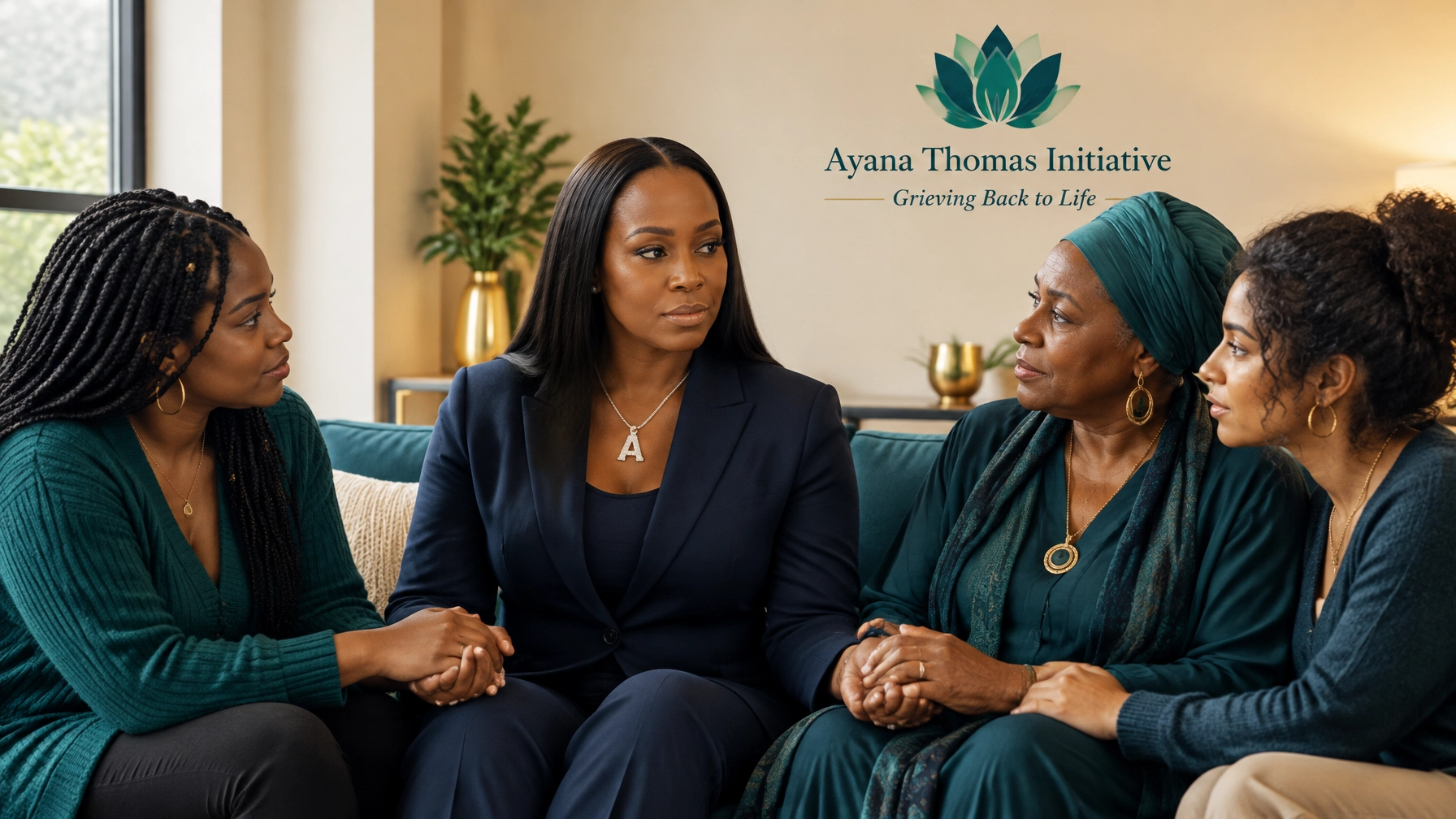
Women navigating trauma, incarceration, family disruption, and identity loss deserve grief healing that recognizes the whole story.

Women navigating trauma, incarceration, family disruption, and identity loss deserve grief healing that recognizes the whole story.
Not only the loss of a loved one.
You may be grieving freedom. Family connection. Trust. Safety. A relationship. A career. Your sense of self.
These losses are real, even when no one names them.
AYANA's Grief Method™, the signature method of The G.R.I.E.F. Initiative™, offers a practical, healing-centered path for recognizing disenfranchised grief and moving forward with dignity. It does not ask you to erase your past, rush your healing, or pretend everything is fine.
It helps you build a future while honoring what happened.
What Is Disenfranchised Grief?
Disenfranchised grief is grief that is overlooked, minimized, or unsupported by society.
You may hear:
- “At least you’re still here.”
- “You need to move on.”
- “That happened a long time ago.”
- “You made your choices.”
- “Be strong for your family.”
But strength does not mean silence.
You can take accountability for your actions and still acknowledge what you have lost. You can work toward reentry and still grieve the years, relationships, and opportunities disrupted by incarceration. You can love your family and still mourn the distance between you.
Your grief does not need public approval to be valid.
Did you know?
In 2011, approximately 1.2 million women were under correctional supervision in the United States, including women who were incarcerated or on probation or parole. That figure is often used to describe the scale of women impacted by the criminal legal system.
More recent Bureau of Justice Statistics data reports approximately 980,300 females under correctional supervision in 2023. The population has changed, but the need for grief-informed care remains urgent.
Many of these women are navigating the loss of freedom, family roles, identity, relationships, stability, and self-worth, often without meaningful grief support.
Our Mission
Our mission is to create trauma-informed, judgment-free spaces where people can acknowledge, process, and integrate grief in all its forms.
We believe healing must include both dignity and accountability. We believe grief can influence behavior, relationships, decision-making, and well-being. We believe you are more than your record, your trauma, your worst decision, or the label placed on you.
AYANA's Grief Method™ helps you move from naming the loss to rebuilding a life that reflects your values.
AYANA's Grief Method™: Five Steps Toward Healing
A — Acknowledge
Naming the loss honestly is where healing begins.
Not just the losses people easily recognize.
The hidden ones too. Freedom. Family connection. Identity. Safety. Self-worth.
In AYANA's Grief Method™, Acknowledge means ending the silence and telling the truth about what happened. It means you stop shrinking your pain to make other people comfortable. You stop acting like what changed you did not matter.
You name what was taken.
You name what was fractured.
You name what still aches.
This is how disenfranchised grief begins to breathe.
What you name, you no longer have to carry in silence.

Y — Yielding
Yielding is not weakness.
It is not giving up.
It is not losing control.
In AYANA's Grief Method™, Yielding means giving yourself permission to feel what you feel without shame or performance. It means releasing the grip of survival long enough for grief to move. Let the armor loosen.
You do not have to perform strength every moment.
You do not have to swallow every tear.
You do not have to stay emotionally braced just because life taught you to.
Yielding makes room for breath.
Yielding makes room for truth.
Yielding makes room for grief healing.
You are allowed to soften without falling apart.
A — Articulation
Pain changes when it is spoken.
In AYANA's Grief Method™, Articulation means putting language to the pain. Naming what was lost, what it cost, and what you need now. Articulation turns a silent wound into a story that can be shared, witnessed, and carried differently.
This is where your voice returns.
You say what hurt.
You say what changed.
You say what you need.
You may articulate through journaling. Through counseling. Through prayer. Through conversation. Through a room where someone finally knows how to listen.
Words do not erase grief.
But they do help you stop drowning in what stays unnamed.
When grief finds language, healing finds direction.
N — Navigation
Grief does not move in a straight line.
Healing after trauma does not move in a straight line.
Reentry, recovery, rebuilding, reconnection. None of it is linear.
In AYANA's Grief Method™, Navigation means moving through grief with intention and practical steps — grounding routines, boundaries, connection, and realistic goals for reentry and daily life. Navigation is not rushing past the loss; it is walking forward while honoring it.
This step is about daily steadiness.
A routine that helps.
A boundary that protects.
A connection that nourishes.
A next step that is realistic.
You do not need a perfect plan.
You need support for today.
Then tomorrow.
You can move forward without abandoning what you have been through.

A — Access
Healing deepens when support becomes reachable.
In AYANA's Grief Method™, Access means reaching for the support, resources, and relationships that make healing possible. Access means you were never meant to do this alone — grief-informed care, community, and healing-centered spaces are part of the path.
This is the step that reminds you help is not a weakness.
It is wisdom.
It may look like grief-informed counseling.
It may look like community.
It may look like trauma support for women.
It may look like mental health support that meets you with dignity.
It may look like one safe place where your story does not have to be edited to be believed.
Support is part of the method.
Support is part of the healing.
Support is part of the future.
You do not have to heal alone to heal well.
Did you know?
More than five million children in the United States — approximately 7% of all children — have experienced the incarceration of a residential parent at some point in their lives.
Many of these children carry separation, instability, stigma, confusion, and ambiguous loss — the grief of a parent who is alive but unable to be fully present.
Healing must include families, not only individuals, because a sentence touches a whole family tree.
How to Use AYANA's Grief Method™ in Everyday Life
AYANA's Grief Method™ is not a straight line.
You may acknowledge the truth on Monday, yield to your emotions on Tuesday, and need to articulate your pain again on Wednesday. You may begin navigating your next steps and realize you need greater access to support. You may move forward in one area while still grieving another.
That is not failure.
That is healing in motion.
Try asking yourself:
- Acknowledge: What loss am I being honest about today?
- Yielding: What feeling am I trying to outrun or control?
- Articulation: What do I need to put into words?
- Navigation: What helps me move through today with steadiness and dignity?
- Access: What support, resource, or connection do I need right now?
You do not have to answer every question at once.
Healing Is Possible, and Support Matters
AYANA's Grief Method™, the signature method of The G.R.I.E.F. Initiative™, can be used in individual counseling, group workshops, reentry programs, court-involved settings, and organizational support.
Our individual grief counseling supports loss connected to trauma, identity, incarceration, and life disruption. Our Grief Behind the Gavel™ curriculum helps justice-impacted adults explore how grief influences behavior, choices, and engagement with the legal system through a grief-informed lens rooted in AYANA's Grief Method™.
You can also learn more about our mission and healing-centered approach or contact our team when you are ready.
Grief is hard, finding help doesn’t have to be.
Your story is not finished.
Your identity is not lost forever.
Your future is not disqualified by your past.
We believe healing becomes possible when grief is named, witnessed, and met with the right support.
Sources and Further Reading
- Bureau of Justice Statistics: Correctional Populations in the United States, 2023
- Bureau of Justice Statistics: Correctional Populations in the United States, 2021
- U.S. Department of Health and Human Services: Incarceration and Family Review
- The Ayana Thomas Initiative: About Our Work
Contact
Ayana Thomas Initiative LLC
Website: www.grievingbacktolife.com
Email: ayana@grievingbacktolife.com
Phone: 862-240-3260
About the author
Dr. Ayana Thomas, Grief Practitioner AKA The Grief Doctor, brings over 20 years of experience at the intersection of human services, grief support, and justice-impacted systems. As the founder of Grieving Back to Life, Ayana’s work centers grief beyond death, addressing loss tied to trauma, incarceration, identity, and life disruption through trauma-informed, dignity-centered care.
Her approach combines lived experience and professional practice, creating spaces where grief is witnessed, not fixed, and healing unfolds at a human pace.
Gentle next step
If you’re considering reaching out, you’re welcome to contact us when you’re ready